Research perspectives on the use of AI

Artificial intelligence offers incredible possibilities for dealing with data. This is of interest to society at large as well as to researchers in all fields. There is also a lot of research being done into the use of AI in support of teaching and learning. New research papers are published every day. One of the authors of this guide, Johannes Pernaa from the University of Helsinki, is actively researching the use of AI in chemistry education.

From a research perspective, it is interesting to see how generative AI applications change the information behaviour of teachers and learners. Information behaviour refers to the interaction between people and information or information channels. The goal of information behaviour is to satisfy information needs, i.e. to solve problems.
AI is changing the way we search for information

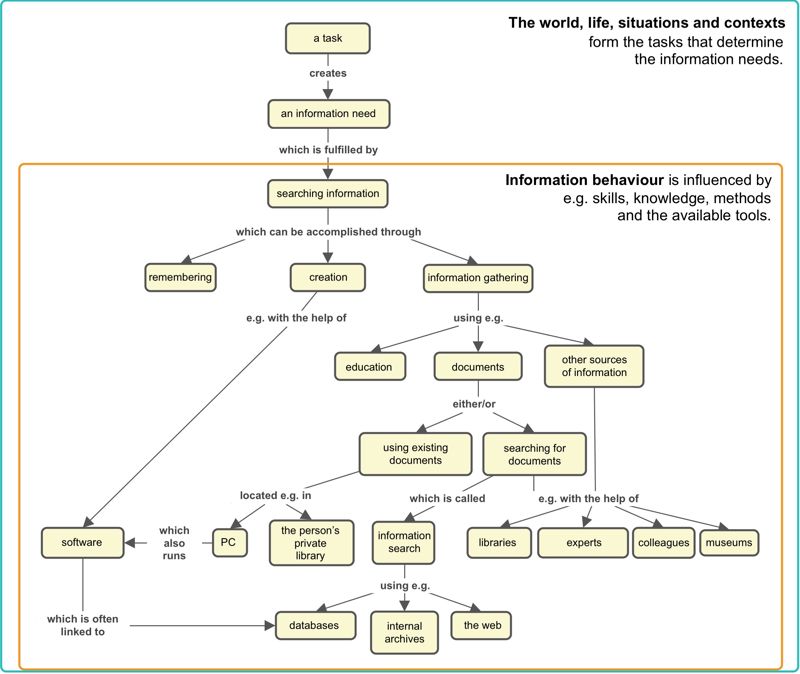
A task creates a need for information, which is then satisfied by information behaviour. Information behaviour therefore consists of searching for information, such as remembering, creating or acquiring information. Different ways of searching for information include education, interacting with memory organisations, talking to experts, as well as traditional web searches using search engines.

In this context, it is interesting to consider the possibilities that AI offers for information retrieval. This can be explored, for example, by analysing different tasks in which students use AI (see Pernaa et al., 2023).

A concept diagram showing the relationship between the need for information and the search for information.
The relationship between the need for information and the search for information.

Example 1: Writing a summary

Students were asked to read an article and write a summary using AI. The use of AI changed the focus of the task from writing to editing and checking the text.

Example 2: Drawing a concept map

Another example was to create a concept map of about 20 concepts related to a chemical phenomenon. The initial assumption was that students would remember about 15 concepts, but could benefit from the AI-generated concept suggestions to expand their memory. This allowed each person to have access to a personal tutor with whom they could discuss the topic.

Example 3: Building a chemical measuring instrument

The third exercise was very challenging. The teacher trainees had to build a chemical measuring instrument for the Arduino computer. This always requires programming, which the students had no knowledge of. Programming is not normally taught to chemistry teacher trainees. This poses a challenge for course design in terms of workload, as the maximum of 135 hours of work must not be exceeded. Fortunately, generative chatbots turned out to be excellent tools for generating software code. The code generated by the chatbots was barely functional, but it helped to lower the learning threshold so that everyone could get started.

What happens in practice?

When working with information, a key analogy is the refinement of information as learning progresses. In other words, information is first refined from data to information, then to knowledge, and finally to contextualised knowledge. This process takes a lot of work and time, but AI can be very useful in making the refinement process more efficient.

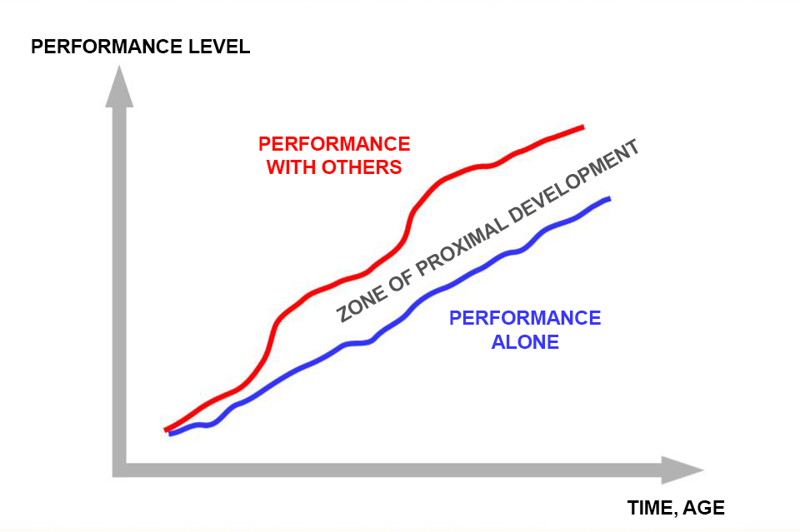
As learning is also a social phenomenon, the potential of new technologies cannot be assessed solely in terms of content. From a social point of view, one of the key objectives for new educational technology is to consider how it can support the expansion of the learner's zone of proximal development (ZPD). The ZPD is a concept from the psychology of learning, coined by Lev Vygotsky. It refers to the area between the learner's current and potential competence. Traditionally, ZPD is developed through group work and teacher support, but AI offers new resources for this process.

For example, when dozens of students have dozens of conversations with AI about software code, the teacher's time is freed up for other interactions that support learning. Creating more time for interaction is very valuable in the busy day-to-day work of a teacher.

A graph showing the basic idea behind the zone of proximal development. The performance level with others and alone increases with time and age. The zone of proximal development is located between the performance with others (typically higher relative to age) and performance alone (typically lower relative to age).
The basic idea behind the zone of proximal development

Implementing AI in teaching

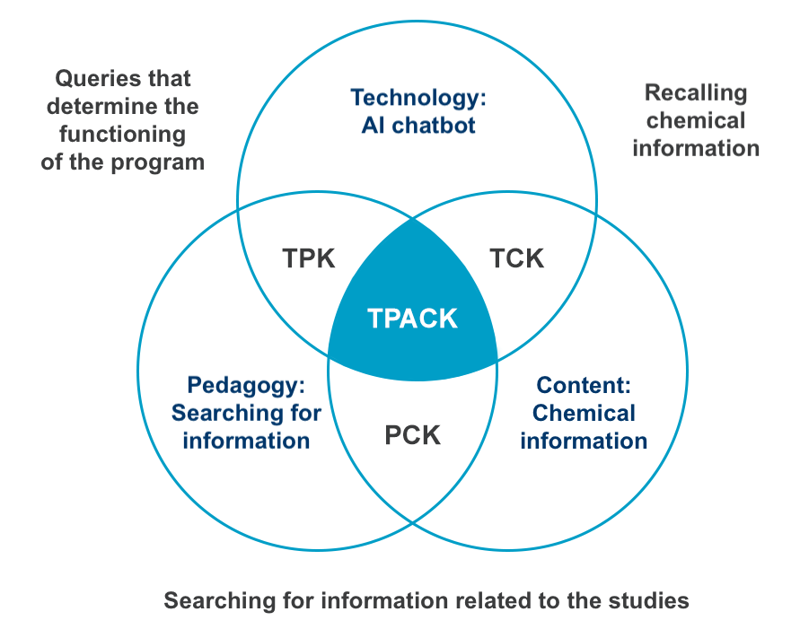
Don't be afraid if using AI in your classroom seems challenging at first. This is because the use of AI requires a lot of planning. The famous Technological Pedagogical Content Knowledge framework, better known as TPACK, can be used to make sense of the big picture.

For example, the TPACK framework helps the teacher to consider

  • to which thematic subject the use of AI could be linked (technological content knowledge (TCK))
  • what the educational goal of the use of AI is (TPK and PCK).

Without taking each of these elements into account, the end result can be difficult to understand for both the teacher and the learner. The best results are achieved in small steps. You can always start with small experiments and then move on to bigger challenges.

A Venn diagram of the TPACK framework.
An example of how to make use of the TPACK framework

Additional information

The perspectives discussed in this chapter have been discussed in more detail in the following article:

Pernaa, J.; Ikävalko, T.; Takala, A.; Vuorio, E.; Pesonen, R.; Haatainen, O. "Artificial Intelligence Chatbots in Chemical Information Seeking: Educational Insights through a SWOT analysis." Preprints 2023, 2023121066. https://doi.org/10.20944/preprints202312.1066.v1