Why digital materials?
Digital learning materials have many advantages over printed materials.
Illustrative multimedia content
Digital learning materials provide a wide range of media content that support teaching and learning, including videos, animations, image galleries, audio files and simulations. Research has shown that animations and simulations can help learners to understand difficult or unfamiliar topics by providing an understanding of the dynamic nature of the phenomena. For example, how can you teach primary school children about the heart and circulation in an accessible way without using illustrative animations or simulations? Videos, on the other hand, can also support safe working practices, for example (see Pernaa, 2016).
Multimedia content is nothing new in the history of digital learning. The advantage of a digital textbook is that the media content is always available in the same place and easily accessed by both teachers and learners. This saves the teacher valuable time that would otherwise be spent searching for videos and simulations.
Another advantage is that a publisher that specialises in digital learning materials and the authors of digital textbooks are well placed to take quality multimedia production into account when creating their textbooks. The end result is high quality digital learning material.
Up-to-date materials
Digital learning materials can be easily updated based on new information and research findings. This keeps them up-to-date and in line with the needs of the modern world.
For example, one of the authors of this guide, Simo Veistola, remembers having himself taught European geography in the year 2000 with a book that still covered the geography of East Germany, although the two German states had united eleven years before.
The other author of this guide, Johannes Pernaa, is a chemistry and biology teacher by training. Johannes finds it easy to keep e-Oppi's chemistry textbooks up-to-date on issues such as safety. For example, there have recently been huge developments in the details of chemical waste management.
Always available
Digital learning materials are easily accessible on different devices, allowing flexible learning anywhere and anytime. A digital textbook cannot be accidentally left at home or at school.
Listening option
The texts of e-Oppi's materials can be listened to. This is particularly useful for auditory learners to absorb the subject matter, but also supports other types of learners by providing a variety of learning techniques. For example, the textbook can be listened to on the way to school or while jogging.
Making the teacher’s job easier
Many features of digital learning materials are designed to help the teacher. For example, tasks that check themselves automatically free up the teacher's time for teaching and tutoring. At the same time, students receive direct feedback on their performance and can monitor their own learning. By using the performance data available on the platform, the teacher can easily find out what needs to be clarified and what the learners already know.
Useful search tools
The search tool helps teachers and learners to find more information on a topic. This is useful for example when revising for an exam. At the same time, teachers can also use the search tool for planning their lessons. If they want to use the materials in a multidisciplinary study unit, they can easily find the subjects, chapters and tasks in the digital textbook library.
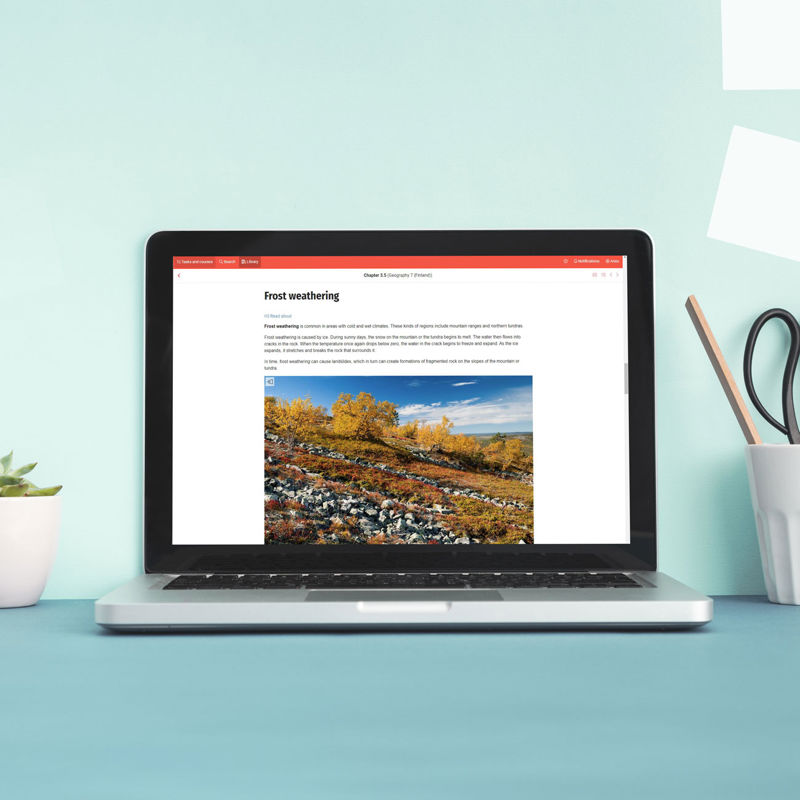
How can digital materials be used for differentiation?
Downward differentiation
The users of e-Oppi's textbooks (teachers and students) have access to the entire digital library of over 100 books (about 40 of which are in English). This means that a middle school student can use primary school materials to support their learning, a high school student can use primary school materials, and so on. (Requires an Opiq+ licence for the student)
Upward differentiation
The users of e-Oppi's textbooks (teachers and students) have access to the entire digital library of over 100 books (about 40 of which are in English). This means that a middle school student can use high school materials to support their learning, a primary school student can use middle school materials, and so on. (Requires an Opiq+ licence for the student)
Differentiation both upwards and downwards is easy in the digital learning environment. The digital textbooks provide teachers with a search tool to find material from primary school, middle school and high school to use in their teaching. Materials are available both in English and Finnish.
The More like this function shows you conveniently which books in other grades and subjects cover the topic in question. Both the teacher and the Opiq+ licence holder have access to other works via links.
Individual differentiation
The teacher can send individual tasks to individual learners if they need more practice or easier/difficult tasks. Similarly, a learner can easily be instructed to progress through the book at a different pace to the rest of the class, while the teacher can monitor his or her progress in real time.
Independent study
Learners can read the theory texts in the book, use the multimedia content, listen to the text and test their knowledge with automatically checked exercises. They can use the feedback they receive from the exercises to check their knowledge and review what they don't know yet.
Other forms of differentiation
Many students working with English-language materials in international schools use English as their second language. Listening to the texts while reading them can help these learners to absorb the language and practise their reading skills while studying the content.
International students in Finnish schools can also use the Finnish versions of the books to learn and practise Finnish.
Learning monitoring
Varied and automatically checked tasks
e-Oppi's digital textbooks include automatically checked exercises such as multiple-choice tasks, fill-in-the gap tasks and quizzes. These varied exercises help teachers to monitor learning progress both at the level of the individual student and at the level of the group as a whole.
Automatically checked tasks also give the learner immediate information about their skills. This improves the learner's motivation through automatic feedback ("I can do it!"/"I still need to practise this.") and redirects learning to things that still need to be practised.
Analytics as a tool for learning
The learner and the teacher can monitor learning and task completion through the analytics available of the digital learning platform. This possibility reduces the teacher's workload, as there is no need to check tasks or their completion, but the results are still automatically made available to the teacher in clear overviews. The teacher can easily see what the learners have mastered and what needs to be repeated or clarified.
Sources
Pernaa, J. (2016). Information and communications technology in chemistry education (Tieto- ja viestintätekniikka kemian opetuksessa.) LUMAT-B: International Journal on Math, Science and Technology Education, 1(2), 38–42. Accessed at https://journals.helsinki.fi/lumatb/article/view/1222