1. First steps for the teacher
- Begin by experimenting.
- Make a plan of how you intend to use AI in your teaching.
- Explain why you are using AI to yourself (and to others).
- Digital education
- Increasing motivation
- Differentiation
Remember to monitor that students do not use AI to replace their own learning process!
2. Beginning the use of AI in school
- First, students must be taught what artificial intelligence (AI) is. You can use the contents of the previous chapter of this guide as a starting point.
- The rules for using AI at your school should be explained or repeated. There can also be national or regional guidelines that should be checked and followed.
- Give the students a few examples of the use of AI. Make sure that all students know a couple of applications.
- A good AI tool to start with is Perplexity, which does not require users to log in to the service.
- Show the students how to give a prompt to a chatbot such as ChatGPT or Copilot.
The three steps of giving an AI prompt
- Context: “I am a teacher at a middle school.”
- Task: “Write...”
- Output: “a 100-word summary.”
The CREATE guideline for giving an AI prompt
- C: Context
- Explain the context in which the AI is supposed to answer the prompt.
- Example: "I am a teacher in a middle school."
- R: Request
- Bad example: "Write a letter to the minister for education."
- Better example: "Write a letter about the importance of sports education in schools to the minister for education."
- E: Examples
- The prompt can be improved by giving examples
- A: Adjustments
- You can also adjust the output of the AI by writing instructions.
- Examples: "Use short sentences", "Write using simple English", "Only use scientific sources".
- T: Type of output
- Example: "Write a 300-word text with a title and summary."
- E: Extras
- Example: "Only use data from the years 2000–c".
3. How should learning materials and teaching evolve when AI is available to all?
Digital textbooks are full of multiple-choice and fill-in-the-gaps tasks.
- Learners get quick feedback on their skills.
- The data collected from the answers provides the learner and the teacher with information about how many tasks the learner has completed and how well the learner understands the topic. Information is gained about the learner's memorisation, understanding of the topic and even the application of their knowledge.
- Learners often perform these tasks deliberately, without using the learning material or AI to their advantage. → The results reflect the learner's skills and abilities.
Longer writing tasks need careful instructions and supervision. Using AI in these tasks can lead to learners not thinking about the content of the task at all. Instead, they will concentrate on editing the text produced by the AI.
Some tasks should involve the use of AI so that the necessary digital skills are learned.
Lessons should include periods of applying, analysing, evaluating and creating new knowledge, alone or in groups. During these periods, there is often no need for computers at all.
4. Information gathering using AI
Encouraging students to use AI to find out more about a topic can increase their interest in the subject, deepen their knowledge and broaden their terminological vocabulary.
- Home economics: Why is yeast added to the dough when baking bread?
- Foreign languages: Give synonyms for running in (the target language).
- Religion: What does the pope decide?
- History/geography: How did people first inhabit Australia? What were the livelihoods of the Aboriginals?
- Using AI to get started with an essay: Give AI the topic of your essay and ask for thought-provoking questions and arguments, which you can then process into your own essay.
5. Defining concepts using AI
Examples
- Explain what friction is.
- Is my explanation of the phenomenon good? For example, the statement “In photosynthesis, the plant produces oxygen from carbon dioxide” will receive additional suggestions from the AI.
- Make multiple-choice tasks that contain statements about the structure of a cell.
- Use an AI application approved by your school.
- First, define the following concepts in your own words:
- slum
- economic structure
- Ask the AI if your answers are good.
For example: "Is the following definition good? A city is an area where a large number of people live in close proximity." - Return your own definitions of the concepts below, followed by the AI-improved answers.
6. The pupil as an actor
Asking for questions – independent study, e.g. in languages
- “I'm 10 years old. Ask me the English names of five animals.”
(Guide the students to return a screenshot of their conversations.) - “Make me five exercises about first-degree equations.”
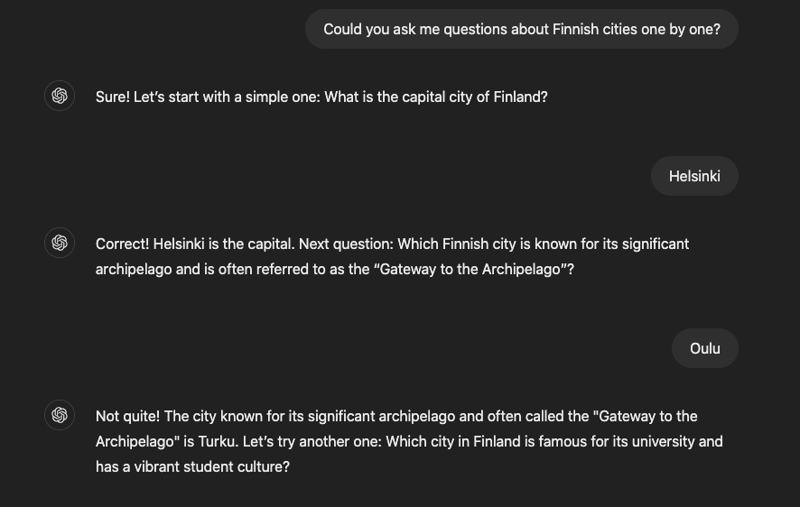
Asking for examples – testing
- “I am a primary school student. Ask me five questions about Finland's climate.”
Asking for feedback
- “Is this a good explanation: ‘In photosynthesis, plants produce oxygen from sugar’?”
Using AI as a source for estimates
- “I am studying the sugar consumption of six pupils. I got the following annual consumption estimates for the six pupils: A: 10 kg, B: 20 kg, C: 30 kg, D: 45 kg, E: 100 kg, F: 200 kg. Estimate the sugar consumption of the pupils from a health perspective.”
7. Using AI as a virtual conversation partner
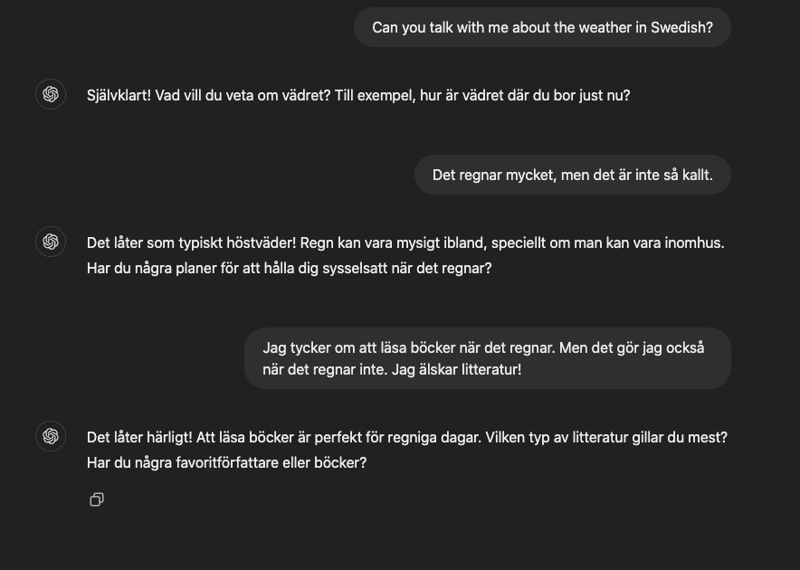
You can ask the AI to talk with you in a foreign language.
You can tell the AI your language level so that it doesn't use vocabulary that is too difficult. You can also ask the AI to clarify and explain difficult words, just as you would in a real conversation.
8. Using AI as a translation tool
1. Use an AI application approved by your school.
2. Make an assignment for the AI: Translate the text below into your target language.
Europe covers about 10.18 million km2 (3.93 million sq mi), or 2% of Earth's surface (6.8% of land area), making it the second-smallest continent (using the seven-continent model). Politically, Europe is divided into about fifty sovereign states, of which Russia is the largest and most populous, spanning 39% of the continent and comprising 15% of its population. Europe had a total population of about 745 million (about 10% of the world population) in 2022; the third-largest after Asia and Africa. The European climate is largely affected by warm Atlantic currents that temper winters and summers on much of the continent, even at latitudes along which the climate in Asia and North America is severe. Further from the sea, seasonal differences are more noticeable than close to the coast. (Source: Wikipedia.)
3. If necessary, improve and edit the AI translation. Return the finished translation below.
9. Using AI to make a diagram
- Use an AI application approved by your school.
- Give the AI a task: “Create a table with the population and area of the following countries (for example, name five countries) and their population density.”
- Ask the AI: “How do I use Excel (or some other spreadsheet program) to make a diagram of the data from the previous task?”
- Follow the instructions and make the diagram.
- Return the table, the diagram and a short summary of the results as a file or link.
10. Using AI to draw images
Sometimes drawing can be too difficult or time-consuming for the task at hand. In such cases, AI can be used as a drawing tool.

Many AI programs can be used to make drawings. Examples include Canva and Playground.
Drawing is sometimes too difficult or time-consuming. In such cases, AI can be used as an aid. Below are some examples.
- Make a drawing of your feelings using AI. For example, you may want to draw a happy cat. In this case, your prompt could be something like “a happy, black cat on a lawn”. Improve the drawing by refining the prompt. Transfer the work to a drawing program or print it and improve the drawing. Be ready to show your work to others.
- History: Draw a society from the past. Prepare to describe the history and features of this society.
- Home economics: Draw a good breakfast. Prepare to explain why you chose this breakfast and why it is good for you.
- Languages: Draw a room with many objects. Name the objects in at least three languages.
- English/Writing: Prepare to write an essay. Draw a cartoon based on your topic using AI.
11. Using AI to draw an image template
Many artificial intelligence tools can be used to create drawings. Examples of such tools include Canva and Playground.
Your aim is to create a landscape in Central Europe, with steep mountains, a glacial U-valley, and conifers growing on the slopes.
- Use an AI tool of your choosing to create a drawing.
- Make your drawing better by specifying the prompt.
- Move the drawing into an image editing software.
- Number the most important features of the landscape.
- Explain how the numbered features of the landscape have evolved. For example: “1. The mountains are tall, steep and sharp, because they are young orogenic mountains. They have been formed...”
- Return your drawing and explanations as a single file or link.

12. Perplexity and ChatGPT – usage examples
Below you will find examples of how you can guide the common Perplexity and ChatGPT chatbots.
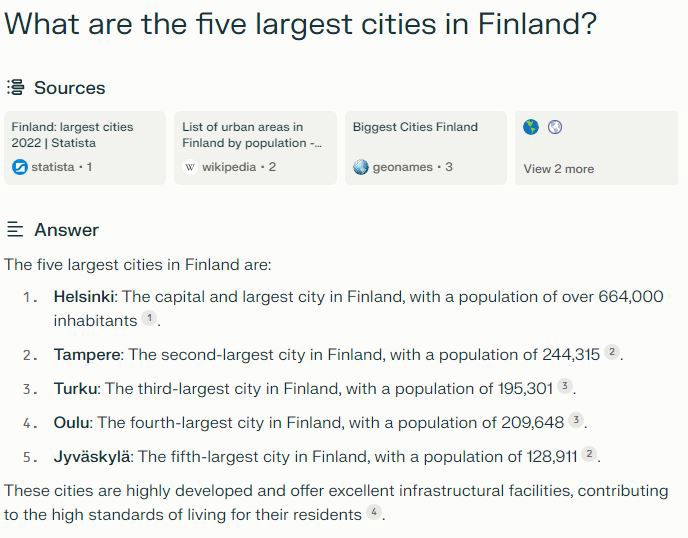
Example: Instructing Perplexity
- Write a question: “What are the five largest cities in Finland?”
- The AI will give you a clear answer and also the sources it has used.
Example: Instructing ChatGPT
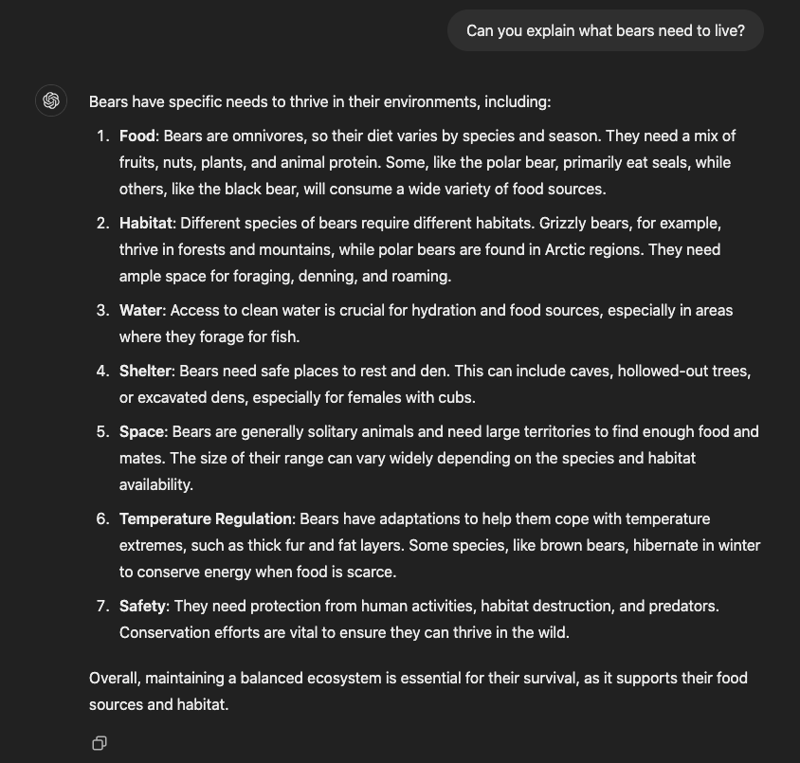
1. Give the AI a task: "Explain what a bear needs to live". The answer will be a long piece of text.
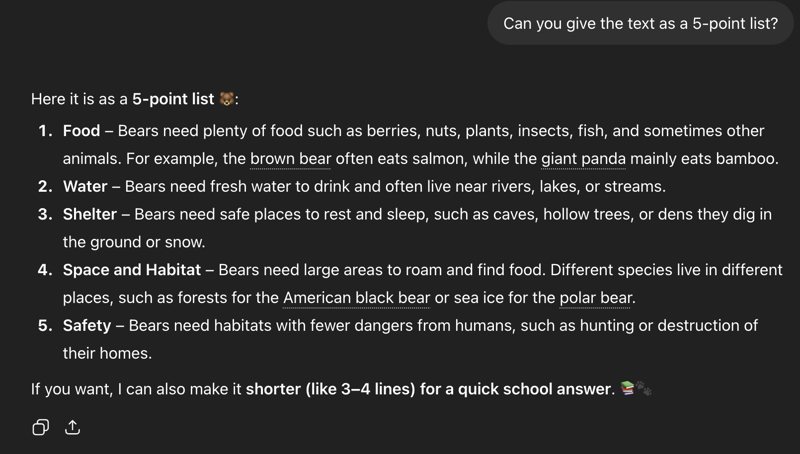
2. Refine the task: "Make a list of seven points from the above text." ChatGPT will give you a list of the most important points.
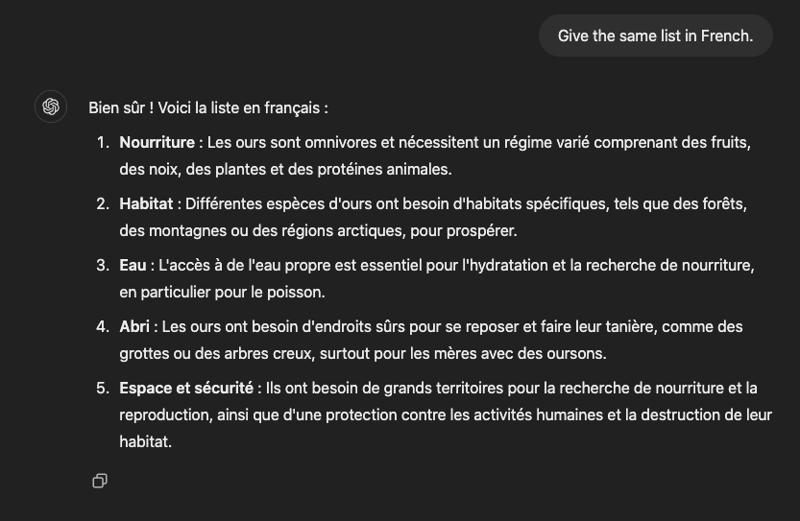
3. Tell the AI to translate the list into another language: "Give the same list in French."
13. Music and AI
Producing and editing music with AI is becoming easier all the time, as new applications emerge.
Below are some examples of useful tools:
- Aiva: A free application that allows you to edit audio tracks.
- Soundful: An application that allows you to create copyright-free background music
- Ecrett Music : Like Soundful, this AI music generator allows you to create copyright-free music.
Additional information
- e-Oppi has already added tasks to some of its digital textbooks that instruct and guide learners in the use of AI. At the moment, these tasks are available in English books for biology, geography and physics at the high school and middle school levels.